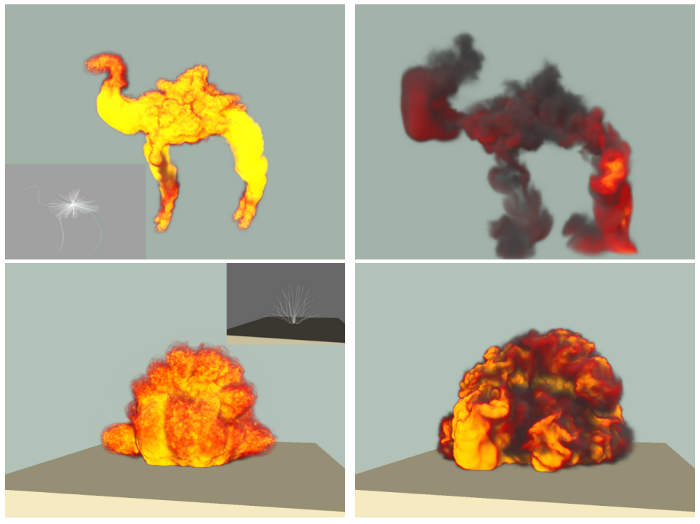
We propose a method to procedurally model the fluid flows of explosion phenomena by taking physical properties into account. Explosion flows are always quite difficult to control, because they easily disturb each other and change rapidly. With this method, the target flows are described by control p … Continue reading “Procedural Fluid Modeling of Explosion Phenomena Based on Physical Properties”
Category: Computer Graphics
A Fast and Practical Method for Animating Particle-Based Viscoelastic Fluids
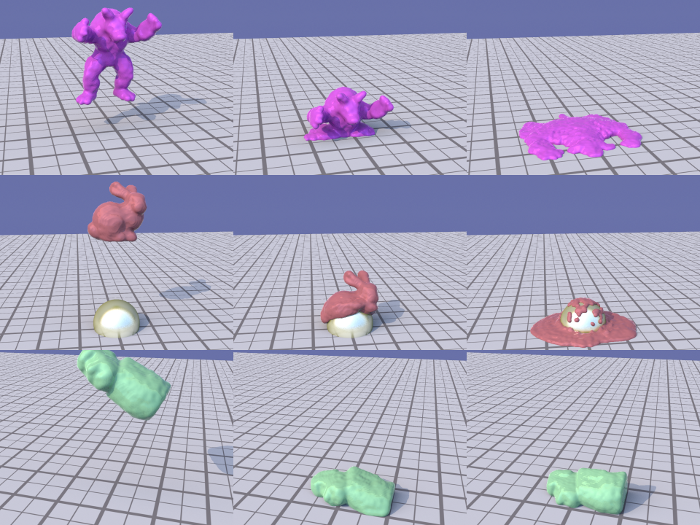
This research proposes a practical technique for fast animation of materials such as viscoelastic fluids. A fast animation of such materials is desperately desirable especially for real-time applications such as games. We compute the behavior of viscoelastic fluids approximately instead of the exact … Continue reading “A Fast and Practical Method for Animating Particle-Based Viscoelastic Fluids”
Volume-Preserving LSM Deformations
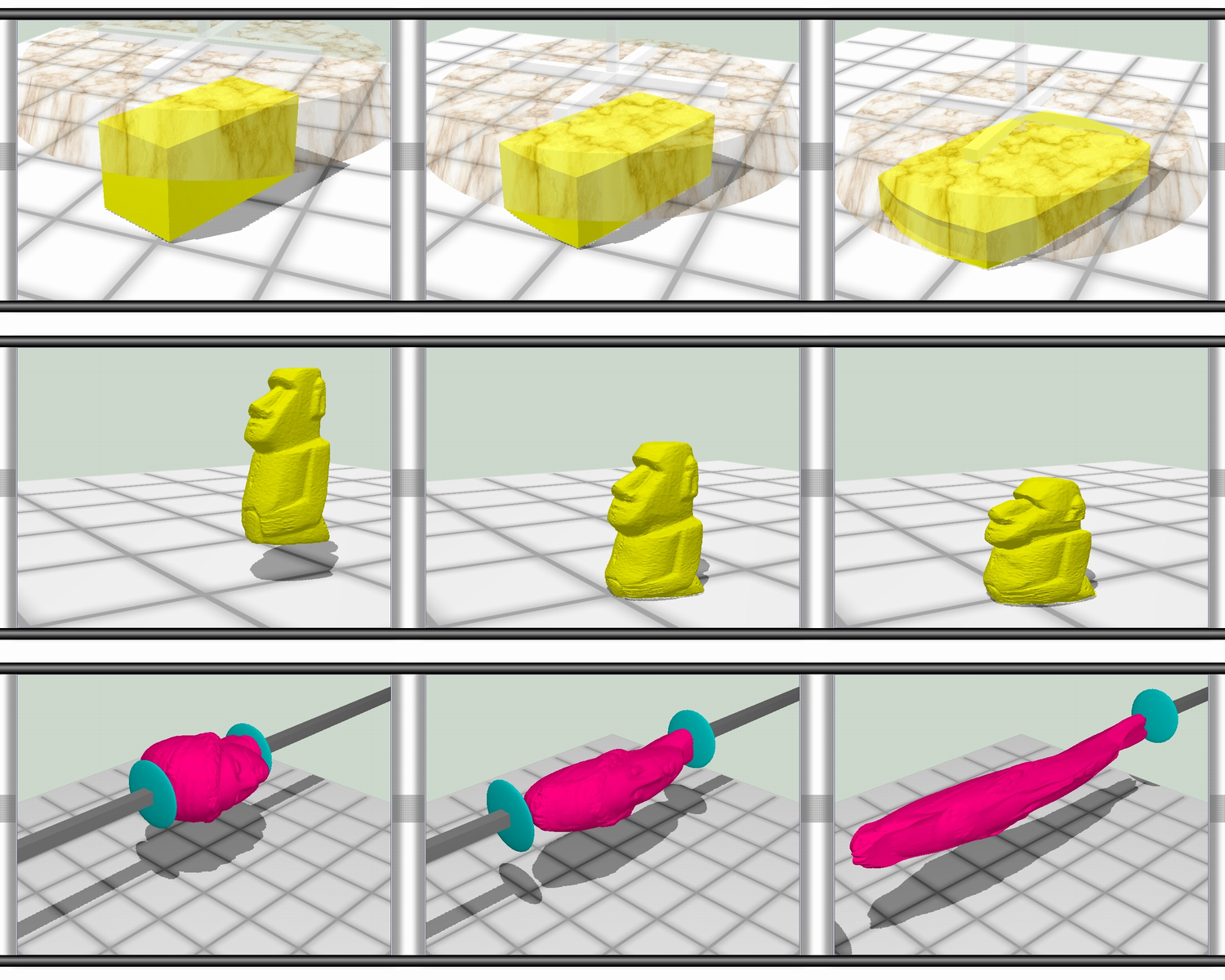
Surface deformations based on physically-based simulations are used to represent elastic motions such as human skins or clothes in the field of 3DCG applications. LSM (Lattice Shape Matching) [Rivers and James 2007] has particularly attracted attention as a fast and robust method which achieves elas … Continue reading “Volume-Preserving LSM Deformations”
GPU-based Rendering of Point-based Implicit Surfaces
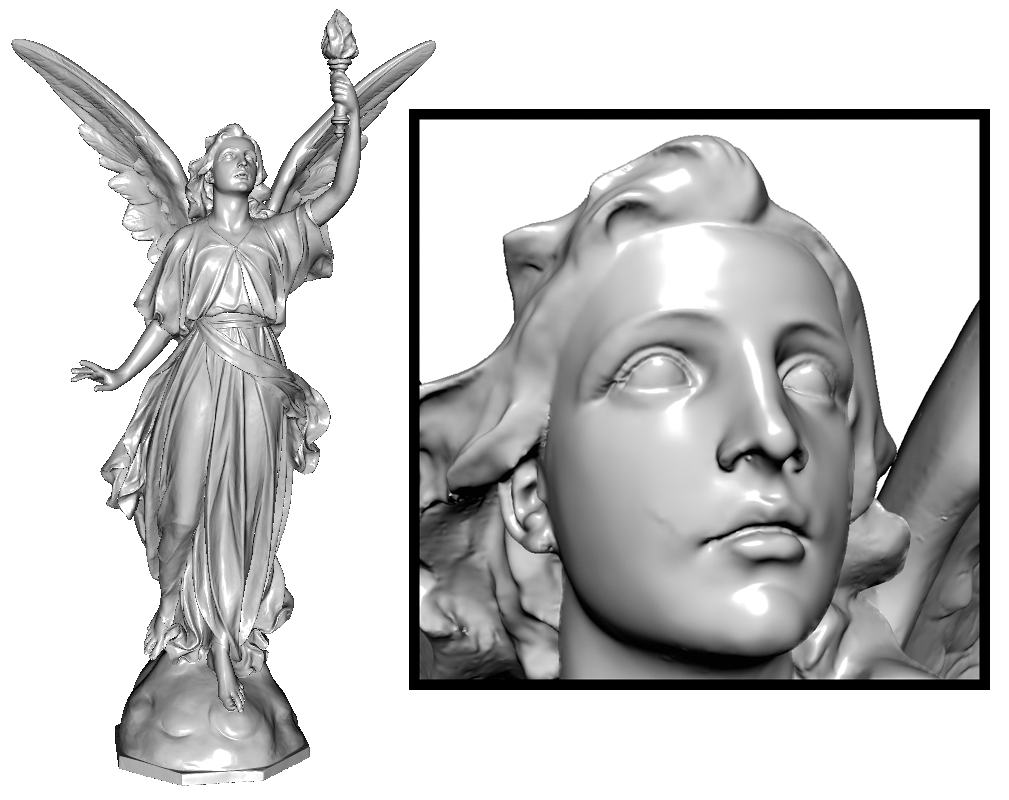
Implicit surface is a well-known surface representation. Geometric details of an object can be represented using less surface primitives than other representations such as polygonal meshes. In this paper, we propose a fast and a direct rendering method of SLIM (Sparse Low-degree IMplicit) surfaces u … Continue reading “GPU-based Rendering of Point-based Implicit Surfaces”
Direct Point Rendering on GPU
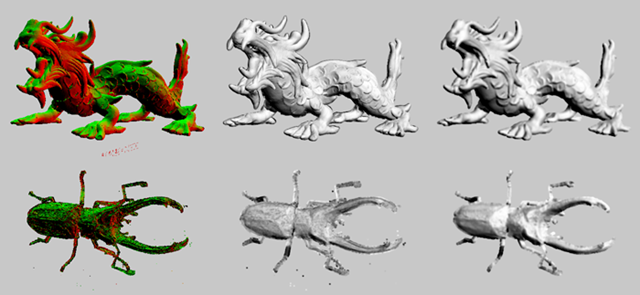
In this paper, we propose a method for directly rendering point sets which only have positional information by using recent graphics processors (GPUs). Almost all the algorithms in our method are processed on GPU. Our point-based rendering algorithms apply an image buffer which has lower-resolution … Continue reading “Direct Point Rendering on GPU”
Directable Animation of Elastic Objects
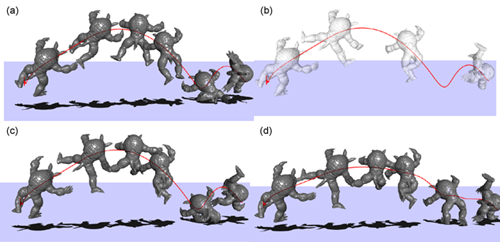
There is a crucial demand in the computer animation industry to make animations that blend animator-specified expressive motion with physics-based realism. We propose a novel framework to create directable animation of elastically deformable objects. The directable animation is created with animator … Continue reading “Directable Animation of Elastic Objects”
Image-Based Point Rendering and Applications
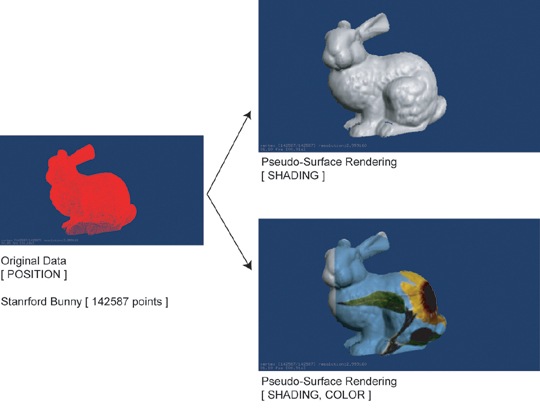
We propose image-based point rendering (IBPR) for multiple range images from 3D scanners. Our approach is a natural extension of the method called pull-push so as to render scanned points with some measurement errors. Several extensions for rendering range images are proposed. One is a seamless rend … Continue reading “Image-Based Point Rendering and Applications”
Interactive Physically-based Animation for Dense Meshes
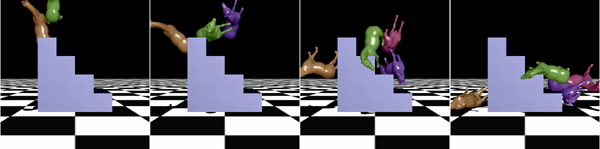
In this paper we describe an interactive physically-based animation system for dense meshes. Our method extracts a coarse mesh from an original mesh to make a tetrahedral mesh for the reduction of computational costs. For computing reaction forces we precompute penetration depth values and gradients … Continue reading “Interactive Physically-based Animation for Dense Meshes”
Hardware-Assisted Relief Texture Mapping
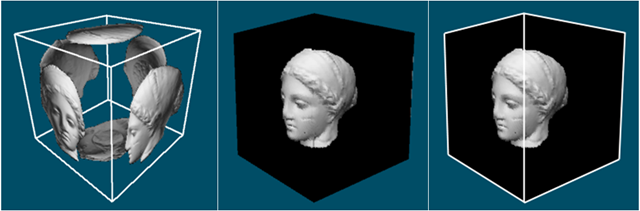
Image-Based Rendering by Warping (IBRW) creates three-dimensional scene by deforming several 2D images with depth information. Image-based rendering has an advantage compared to traditional polygon rendering that the rendering time is still constant even if a scene becomes complex. Relief texture ma … Continue reading “Hardware-Assisted Relief Texture Mapping”